The decentralised finance (DeFi) ecosystem has transitioned from a niche experimental playground to a cornerstone of the global financial evolution. In the United Kingdom, 2026 marks a pivotal year as the Financial Conduct Authority (FCA) and the Treasury have fully integrated the second phase of the Financial Services and Markets Act (FSMA) 2023. For legal scholars and students, the shift from “permissionless” to “regulated” represents a significant challenge in defining where code ends and legal liability begins.
The Complexity of UK Digital Asset Governance
Navigating these legislative waters requires a deep understanding of both traditional contract law and smart contract logic. Many students studying fintech law at prestigious UK institutions often find that the intersection of traditional equity and algorithmic decentralisation creates a steep learning curve. Professional educators provide students with necessary support so they can find an assignment helper uk who understands these specific 2026 regulatory shifts. This level of expert guidance ensures that research into the FCA’s 2026 official guidance regarding “Secondary Liability” rules is both accurate and reflective of current market realities.
Secondary Liability: The DAO Token Holder Trap
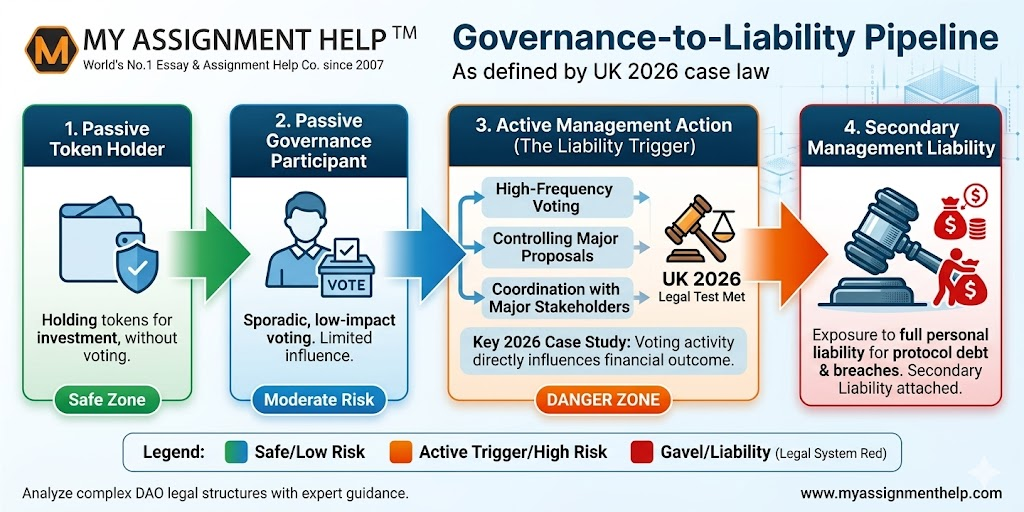
A critical development in 2026 is the FCA’s stance on Decentralised Autonomous Organisations (DAOs). Recent UK court guidance suggests that if a token holder’s voting activity actively influences the protocol’s financial direction, that vote may be legally classified as an act of “management.” This is a significant shift; simple governance participation could now expose individual UK investors to secondary liability for the protocol’s debts or regulatory breaches, effectively treating a DAO like a traditional general partnership.
UK FSMA vs. EU MiCA: The “Travel Rule” Distinction
While the EU’s Markets in Crypto-Assets (MiCA) regulation provides a broad umbrella for Europe, the UK’s 2026 framework is notably more stringent regarding the “Travel Rule.” Unlike several EU implementations that allow for greater flexibility in unhosted wallets, the UK requires rigorous data collection for nearly all DeFi interactions exceeding a minimal threshold. This “gold-plating” of international standards positions the UK as a safer, albeit more restrictive, environment compared to its continental neighbours.
Comparative Table: UK vs. EU Standards
| Feature | UK (FSMA 2026) | EU (MiCA) |
| DAO Liability | Management-based (Stricter) | Entity-based (Flexible) |
| Travel Rule | Mandatory for Unhosted Wallets | Tiered Thresholds |
| Stablecoin Oversight | Bank of England/FCA Joint | ESMA/National Regulators |
Strategic Academic Research: Annotated Bibliographies in DeFi Law
For those drafting dissertations on jurisdictional arbitrage between London and Brussels, organizing sources is a critical skill. To master the literature review process, many researchers choose to Write My Annotated Bibliography as a strategic way to synthesize the divergent views of the FCA, the European Securities and Markets Authority (ESMA), and industry lobbyists. A well-structured bibliography allows a researcher to track the evolution of the “Smart Contract as a Legal Contract” debate across different jurisdictions.
Key Takeaways
- Voting is Management: In the UK, active governance in a DAO may lead to personal legal liability for token holders.
- UK vs. EU: The UK Travel Rule remains significantly more rigorous for unhosted wallets than the EU’s MiCA.
- Institutional Alignment: Traditional UK banks are now only integrating with protocols that prove “Travel Rule” compliance.
- Academic Rigour: Understanding 2026 shifts requires a multidisciplinary approach, blending coding knowledge with British case law.
See also: How Technology Is Improving Healthcare Systems
FAQs
1. Can I be sued for voting on a DAO proposal in the UK?
Under 2026 guidance, if your vote is deemed a “management action” that influences the financial risk or structural integrity of the protocol, you may face secondary liability.
2. Is the UK Travel Rule stricter than MiCA?
Yes. The UK requires more granular data for DeFi-to-unhosted wallet transactions than the baseline MiCA requirements currently enforced in many EU member states.
3. Why use an annotated bibliography for this topic?
The rapid pace of FCA “Dear CEO” letters and court rulings makes it essential to document the context and validity of each source chronologically to maintain academic integrity.
Author Biography
James Arkwright is a Senior Academic Researcher and Content Specialist at MyAssignmentHelp. With over a decade of experience in UK higher education and a focus on fintech law, James specializes in synthesizing complex regulatory frameworks into accessible educational resources. He is a frequent contributor to digital finance journals and provides mentorship to postgraduate law students navigating the intersection of technology and the British legal system.
References (Harvard Style)
- Financial Conduct Authority (2026) Secondary Liability and Governance in Decentralised Finance. London: FCA.
- HM Treasury (2025) The future of digital asset regulation: A consultation response. London: Crown Copyright.
- European Securities and Markets Authority (2026) MiCA Implementation Report: Cross-border Equivalence.
- University of Oxford (2026) The Law of DAOs: Management vs. Membership. Oxford Law Review.